Thursday, November 14, 2013

Grieving in Our Own Way and Time

They may have sat in their cars uncertain and reluctant to enter the building.

They may file into the meeting room filled with apprehension about the strong feelings of sadness they may experience there.

They are participants in an Arbor Hospice grief support group who have lost spouses or partners, children, parents, siblings or other loved ones.

I know from years of experience co-leading these groups that many tears will be shed on that first evening. I also know that many participants will report at our next meeting that the intervening week was a difficult one for them because of the emotions they experienced at that first session.

To better understand what draws participants to these groups given the strong feelings they may evoke, I asked Melissa Schultz, an Arbor Hospice grief support coordinator, what motivates individuals to attend.

She told me that for some participants it is the only place in which they can talk about their losses because the people around them were uncomfortable with the subject or thought that they had grieved enough. Some attend, she said, because they had previously experienced the benefits of social support in dealing with significant life issues.

Participants in these groups have taught me that there is no one right way to grieve, that we each do it in our own way and in our own time.

I have also learned that the vast majority of us who have lost loved ones find our way over time to sustaining memories, a process that is truly at the heart of a grief journey that is for each of us uniquely our own.

This blog entry was written by Dennis Sparks, Arbor Hospice Volunteer. You can contact Dennis by commenting below or emailing him at thinkingpartner@gmail.com.

Tuesday, November 12, 2013

Holiday Feelings of Disconnect

I was recently the co-facilitator for an Arbor Hospice grief support group where a participant noted that as more time passes since her mother's death, the more disconnected she feels from her. This was troublesome because the participant wanted to maintain connection with her mother while healing at the same time. In a way, she is receiving mixed messages: grief is supposed to get easier with the passage of time, yet, she feels that she is starting to let go of her mother in a way that she does not wish to.

I spent the rest of the evening pondering this notion of disconnection. Gone are the days where grief counselors are encouraging clients to completely sever the relationship with the deceased in order to heal. Our profession has shifted to the idea of continuing bonds, that is, maintaining a relationship with the deceased. Instead of a relationship of presence, we talk about a relationship of memories. However, there is still a forced, non-negotiable disconnection with our loved ones when we die, and oftentimes it's a disconnection that we do not ask for.

The holidays are upon us and this is a time of year when feelings of disconnection and loneliness may intensify. For me, I have felt an undercurrent of sadness amidst celebration during the months of November and December that I haven't always been able to pinpoint. Is it the colder, darker days? Financial strains of holiday shopping? Anxiety about upcoming family get-togethers? People missing their loved ones? I think it could easily be all of this and then some.

So, what does one do to successfully navigate the holidays while grieving? The simple answer (if there is one) is to try to maintain some sort of connection with your loved one, especially if this will be your first holiday season without them. A former colleague used to encourage her clients to focus on the legacy of their loved on, more so than on the loss. Perhaps a way to stay connected is to continue with one or two holiday traditions your loved one really enjoyed: preparing their favorite Thanksgiving dish, playing their favorite holiday music, or taking over a role they once performed like lighting the candles on the menorah. Though they may be painful, these small acts are a way to keep your loved one alive and present during the holidays.

Arbor Hospice is offering special holiday workshops to provide more tips on coping with the holidays. The final two workshops will take place this Sunday, November 17 from 2-3:30 p.m. If you live near Ann Arbor, consider attending the workshop at Malletts Creek Library (3090 E. Eisenhower Parkway). If you live in the downriver area, consider attending the workshop at our office at 21647 Allen Road in Woodhaven. You can find more information about these workshops on our website.

If you have experienced the death of a loved on, what are some ways you have found helpful in coping with the holidays?

This blog post was written by Becca White, Arbor Hospice Grief Support Coordinator. You may contact Becca by commenting below or emailing her at rwhite@arborhospice.org.

Monday, November 11, 2013

End of Life Cancer and Massage

arborhospice.org
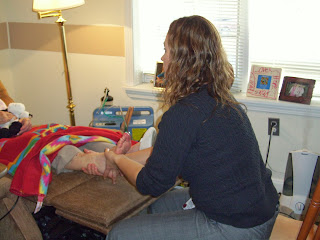
Michelle Chaves-Torres, Arbor Hospice Complementary
 Therapy Coordinator/Massage Therapist, gives an
Arbor Hospice patient a foot massage.
Massage therapy is very beneficial for cancer patients at the end of life. Many patients experience pain throughout their body when cancer has metastasized, and in addition to traditional medicine, massage provides pain relief by relaxing the body. When someone is in pain, it can be difficult to find a comfortable position. Massage offers relief and facilitates the capacity to relax into a more comfortable state.

Massage improves circulation. More often than not, patients at the end of life are not as mobile as they once were. Sometimes they are confined to a bed or chair. Massage helps to stimulate and encourage circulation, providing nutrients and oxygen throughout the body. It helps to prevent pressure wounds in those that are bedbound by keeping the systems and fluids of the body moving.

Massage also decreases swelling often present in the arms and legs due to an impaired circulatory system from radiation or chemotherapy. A certain type of massage, called Manual Lymphatic Drainage Massage, stimulates the circulatory system to move excess fluids out of the body.

On an emotional level, end of life cancer patients may be suffering from depression. Routine massage often alleviates some of the signs and symptoms of depression. Massage stimulates the release of a hormone called an endorphin, a "feel good hormone." Researchers believe that because a massage can promote relaxation and release endorphins, massage can enhance someone's mood.

Sleep deprivation is another common aliment for end of life cancer patients. Massage provides the environment for more restful sleep and/or assists patients into a relaxing deep sleep. I have had many patients tell me "I feel like a new person after receiving a massage," or "I wake up feeling so refreshed."

Patients at Arbor Hospice benefit from massage intervention to alleviate pain, improve circulation and elevate mood. On average, 12-18 patients receive massage treatments per week throughout Arbor Hospice's seven county service area. In a future blog post, I will provide simple steps on how to give a hand or foot massage. That way, you'll be able to give massage therapy to someone you love.

This blog entry was written by Michelle Chaves-Torres, Arbor Hospice Complementary Therapy Coordinator/Massage Therapist. You can contact her by commenting below or emailing her at mchaves-torres@arborhospice.org 

Saturday, November 9, 2013

Hospice Patients Offer The Gift of Possibility and Hope

We had finished recording.

The Arbor Hospice patient had shared her life story in a conversation with her daughter, and the
video camera was turned off.

She moved to a nearby chair where she looked out a large window at the softly falling snow. Jean accepted a glass of wine, and I took a seat across from her.

She had mentioned during the videotaping that social justice was important to her, and we talked a bit about its origins in her life and how she continued to be engaged with these issues in this her 10th decade.

“It’s a wonderful world when people share love and care for one another,” she said.

Jean had mentioned that she wrote poetry, and I asked about it.

She offered to recite a recently-composed two-line poem:

“The long, dark corridor of life narrows at the end. And those whose ego grew too tall will have to learn to bend.”

I share this story with you to remind us that we can be meaningfully engaged with life until its very end, a gift of possibility and hope that hospice patients offer us which enriches the quality of our own days, however many they may be.

This blog entry was written by Dennis Sparks, Arbor Hospice volunteer. You can contact Dennis by commenting below or emailing him at thinkingpartner@gmail.com

Wednesday, November 6, 2013

Oh, The Web I Weave

I feel more like a spider than a sandwich, I thought as I hung up from a futile phone call with my 90-year-old mother who has recently been diagnosed with early Alzheimer's. Her physician has instructed her to take her blood pressure every day to monitor her rising level, and once again she has forgotten to go downstairs to the nurse who is available five days a week in her independent living building.

I'm a Sandwich Generationer, someone with an aging parent who requires my assistance and teenage children at home who need my oversight. It's all good, but I need to build a support web to manage it all. My mom has doctors' appointments; I can schedule those on the weekend (check), a driver assessment, my sister-in-law can take her (check), the boys need to get their senior pictures taken (weekend, check), a doctor's appointment (leave work early, check), an appointment with mom's financial advisor (evening, check); the checklist goes on and on and the support web I weave is sturdy yet fragile.


My husband is my back-up, always ready to jump in and repair a broken thread. So far, somehow, it has all worked. Those of you who have figured this out or have ideas to help manage it all, please pass them along. In the meantime, this spider will keep spinning.

This blog entry was written by Margaret Adrain, Arbor Hospice Vice President of Marketing and Business Development. You can contact Margaret by commenting below or emailing her at madrain@arborhospice.org.

Monday, November 4, 2013

The Courage to Grieve

Let's face it: loss hurts. The death of a loved one, the end of a romantic relationship or friendship, financial hardship, changing jobs - these are all common losses we experience. Sometimes, it can seem like life is a series of losses. In our fast-paced, over scheduled culture, it's easier to keep going without pausing to mourn the cumulative losses we face in our lifetimes. Who wants to take time to feel sadness, anger, guilt or emptiness?

Our society has become very grief avoidant. For example, most employers give three days of bereavement leave following the death of a close relative. We are expected to take a few days off, grieve and then return to work renewed and ready to pick up where we left off. We are encouraged to stuff our grief down deep inside so that we can be productive at work and remain engaged with life. I often talk to bereaved clients who intentionally stop their tears from flowing, drag themselves out of their houses to work, to school or to the community center to become immersed in anything but how they are feeling. Or, the exhaust themselves with exercise in order to be able to collapse into bed at night and avoid thinking about their loss.

It takes courage to open up to grief, to intentionally slow down and sit with its ugliness. And grief isn't just ugly. It's messy. It's unpredictable. It doesn't have neat stages, contrary to popular wisdom. Grief can be raw, unadulterated pain if it's allowed to express itself. And human beings don't like to feel pain, especially when the pain is holistic and affects our thoughts, feelings, behavior and spirit.

Experiencing the pain that comes as a natural reaction to loss is what we must do in order to move through the process and eventually heal. Moving through the pain is made easier with good social support, coping skills and self care. I would argue that even with those in place, something more is needed, and that's courage. The courage to know that perhaps it will be worse before it's better. Or that no matter how many people are willing to help and be supportive, the grief process is a path that ultimately must be walked alone. The courage to believe that you will be okay. The courage to keep reaching for life during the darkest days.

In the coming months, we will be sharing stories, experiences and hopefully inspiration for those trying to courageously live with loss. We encourage you to join our discussion by posting your own comments and sharing what you have encountered as you journey through grief.

This blog entry was written by Becca White, Arbor Hospice Grief Support Coordinator. You can contact her by commenting below or emailing her at rwhite@arborhospice.org.

This blog post was inspired by the writings of Judy Tatelbaum, grief expert and author of The Courage to Grieve and You Don't Have to Suffer. Visit her website or her Amazon.com page.

Friday, November 1, 2013

Why I'm a Hospice Volunteer

"The best way to find yourself is to lose yourself in the service of others." -Mahatma Gandhi

When I tell people that I'm a hospice volunteer, the most common response is, "I admire what you do, but I could never do it."

So, I'd like to take this opportunity to explain why I'm a hospice volunteer:

  • I have always admired those who do hospice work. Nurses, doctors, social workers and spiritual care coordinators. In my view, they are as close to angels as I am likely to encounter in this earthly realm.
  • I felt drawn to hospice work because I saw it was a way I could apply understandings and skills I had spent a life-time developing - to listen deeply and to trust people to find their own best way, a belief that people can learn important things until the very end of life.
  • I thought it was likely that hospice patients and their families would teach me important lessons that could support me in navigating that passage when my time came to do so.
Five years ago when I first considered becoming a volunteer, I talked with a long-time Canadian professional colleague who has volunteered for many years at a southwestern Ontario hospice.

"As a volunteer, I provide a safe place for clients to share their emotions, which they sometimes were unable to do with their own families who are struggling with the imminent loss of a loved one," she told me. "I learned to focus less on the illness and more on the things I could bring to their lives."

She also described personal benefits. Hospice volunteering, she said, "helped me realize what's important and to prioritize my life on a daily basis. And I've been able to use what I've learned to support friends and family who are not part of hospice when they have gone through illnesses and losses in their own lives."

My responsibilities at Arbor Hospice include:
  • Helping patients of all ages and their families preserve family stories and other important memories on video.
  • Co-leading bereavement groups for individuals who have experienced the loss of a loved one.
Through these experiences, I have had the privilege of learning a great deal about end-of-life issues, lessons I will share with you in coming weeks about facing the prospect of death and about grieving those we have lost.

This blog entry was written by Dennis Sparks, Arbor Hospice Volunteer. You can contact Dennis by commenting below or emailing him at thinkingpartner@gmail.com.